
There are two credible routes to the scent in a body care line, and they sit at opposite ends of the same spectrum. Route A hands development to the factory's perfumers, who build on their own accords and bases; Route B brings in your own independent perfumer and uses the factory only for format adaptation and production. Neither route is better in the abstract; they differ in cost shape, speed, exclusivity and creative control. Decide on those four, and the choice makes itself.
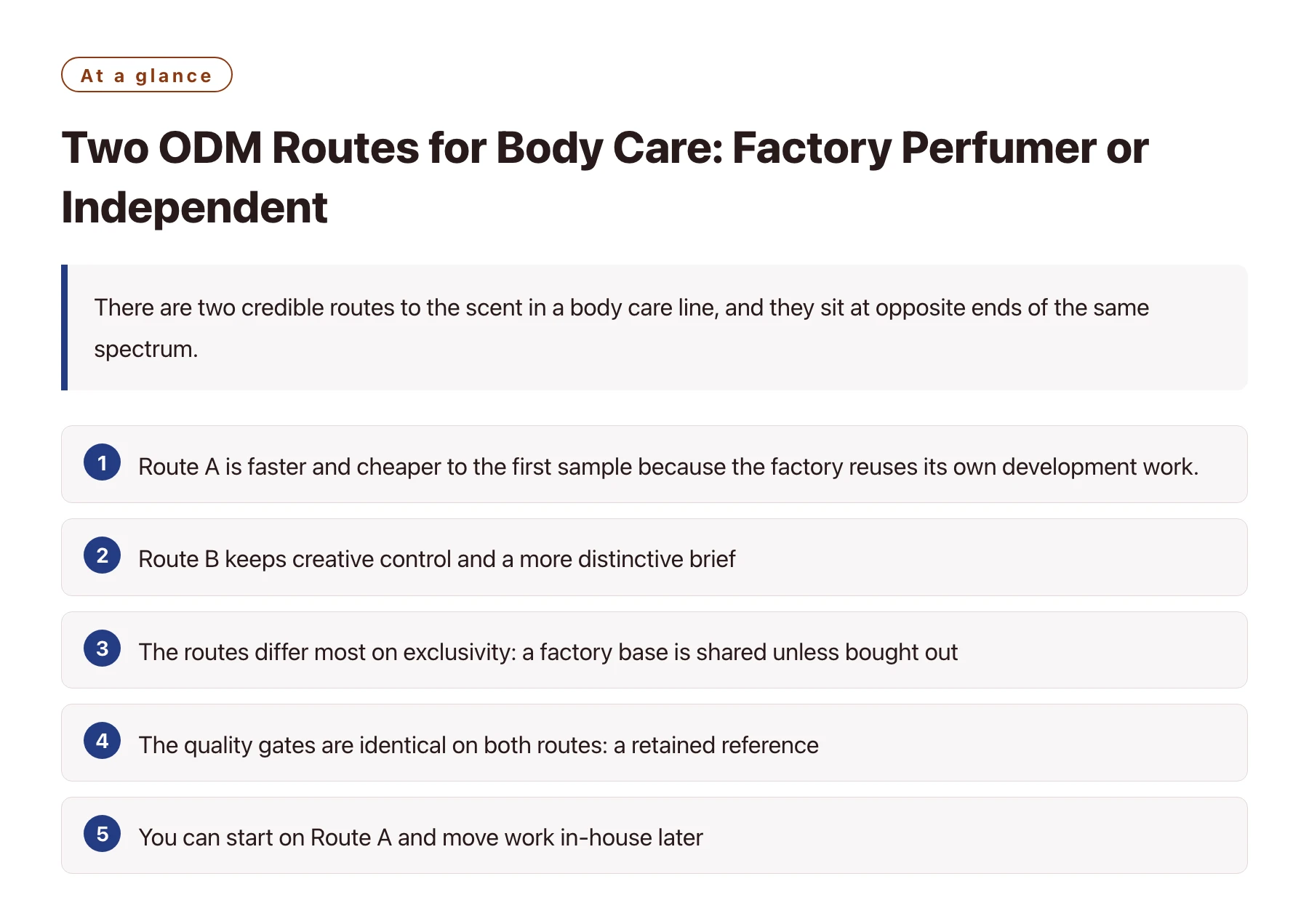
Key takeawaysRoute A is faster and cheaper to the first sample because the factory reuses its own development work. · Route B keeps creative control and a more distinctive brief, but development and integration are paid separately. · The routes differ most on exclusivity: a factory base is shared unless bought out, while your perfumer's work can be exclusive by contract. · The quality gates are identical on both routes: a retained reference, stability on the format, and an allergen and safety file. · You can start on Route A and move work in-house later; what matters is who owns the formula when you do.
Most comparisons of ODM fragrance stop at 'factory makes it' as though that were one thing. It is not. A factory can develop the scent itself, or it can take a formula that already exists and simply reproduce and adapt it.
This article compares those two routes honestly, for a body care line where the format complicates everything that is not the scent.
The two routes in one paragraph each
Route A — factory-developed: your brief goes to the factory's perfumers, who pick accords from their own library, build trials and adapt the winner to the body care base. Development is internal, so it is fast and the price is one project number.
Route B — perfumer-developed: you commission an independent perfumer for the scent, then hand the formula to the factory for format adaptation, stability and production. Development is external, so it is usually more distinctive and always paid for twice: once to the perfumer and once to the factory for integration.
Route A versus Route B, side by side
| Consideration | Route A — factory-developed | Route B — freelancer + factory |
|---|---|---|
| Time to first sample | Shortest, because bases are ready | Longer: brief, rounds and integration |
| Development cost | One project price | Separate fee plus integration work |
| Creative control | Medium, guided by the factory | High, the brief is yours |
| Exclusivity | Negotiated per accord | Written into your perfumer contract |
| Format fit for body care | Factory adapts in house | Factory adapts your formula |
| Best for | First lines, speed, testing a category | Brands whose scent is the identity |
Read the fifth row first: either route still depends on the factory's ability with wash, lotion and oil bases.
The four differences that matter
Cost shape
Route A rolls development into the project and the risk into the factory. Route B separates creative cost from manufacturing cost, which is cleaner to account for and easier to overrun, because integration rounds are rarely forecast well.
Exclusivity and ownership
The factory's starting point is shared unless you buy it out; the perfumer's work is exclusive if your contract says so. Whoever develops the formula, the finished oil still has to sit inside the industry's ingredient restrictions, which are published in the standards library [1].
Quality gates
Both routes finish at the same gates: a retained reference sample, stability on the finished format, and a file your market will accept. The route changes who does the work, not what the work is.
Format integration
Body care integration is the step neither route can skip, because a beautiful accord can die in a surfactant system or an emulsion. Ask the factory how many of these adaptations it has done in your format before you choose a route.
How to choose
If speed and a proven base matter more than a distinctive brief, choose Route A inside a full-service manufacturer: the same team that handles ODM fragrance development also adapts and fills the product, which keeps the calendar short.
If the scent is the brand, choose Route B and keep the factory as the production anchor. Later, when you own the formula outright, the same maker can serve as your fragrance OEM/ODM production partner while you shift the balance of the work.
The trap is choosing Route B but budgeting like Route A. Exclusivity is not a feature you discover; it is a line you negotiate. Decide before the first sample which route's cost shape you can carry.
Sources
- IFRA Standards Library (International Fragrance Association) —— The IFRA Standards Library lists the restrictions the fragrance industry applies to individual fragrance ingredients, based on safety assessments; it is the reference point for compliant fragrance formulation.
Frequently asked questions
Is factory-developed ODM perfume worse than an independent perfumer's?
Not automatically. Factories employ professional perfumers and their bases are tested at scale, which is an advantage for body care. Independent perfumers tend to bring more distinctive briefs. It is a trade-off, not a quality ranking.
Can I make a factory base exclusive?
Usually yes, for a price and within a scope: which accord, which markets, which period. The term should be written in the agreement, because the default is that a base belongs to the factory.
What does Route B integration involve?
The independent formula is rebuilt for the product base, then tested and documented by the factory. Integration is real work with its own timeline, which is why Route B costs more than the perfumer's fee alone.
Can I switch routes with the same factory?
Yes. Moving from factory-developed to your own formula is a normal progression. What matters is the ownership clause: if the formula and the mould are yours, the same factory can keep producing them.
Do both routes need the same safety tests?
Yes. The finished format is tested the same way whatever the route, because the market does not know or care who wrote the formula.