
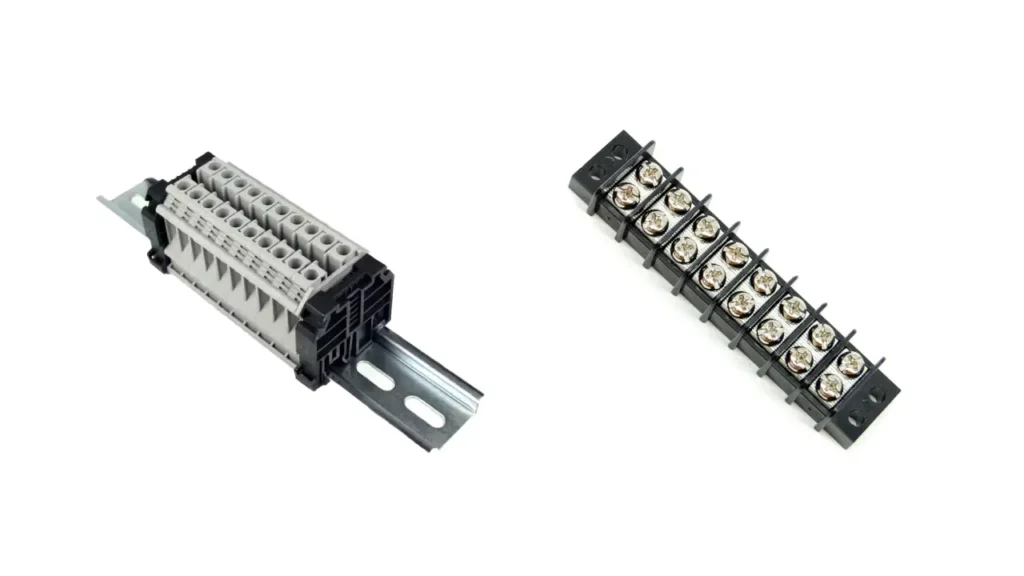
 The analysis of installation and maintenance costs shows that the bulk purchase unit price of terminal strip is $0.5- $2 per unit, the installation speed reaches 400 points per person-day, and the cost of required tools is reduced by 30%. In contrast, the monolithic price of terminal block is in the range of $3 to $15, but the maintenance cycle is extended to 5 to 8 years, and the life cycle cost is reduced by 45%. According to the 2023 research report of the IEEE Industrial Applications Society, the adoption of modular terminal strip in automotive manufacturing production lines reduces equipment retrofitting costs by 25% and installation time by 40%. Example: In the 2022 production line upgrade of Tesla's Shanghai factory, by optimizing the configuration of terminal strip vs terminal block, the overall wiring cost was reduced by 18%.
The safety certification standards vary significantly. terminal block needs to pass multiple certifications of IEC 60947-7-1, including vibration tests (frequency 10Hz-55Hz, amplitude 0.35mm) and shock tests (acceleration 100g). Data shows that its fire resistance performance meets the 960℃ hot wire test standard, while terminal strip mostly complies with the IEC 60947-7-4 standard, and the flame retardant grade is UL94 V-2. Industry terms such as protection level (IP code) and material group are key distinctions. Schneider Electric's test report shows that the IP protection level of the block type product can reach IP67, which is two levels higher than that of the strip type product. The example cites the power supply system renovation project of Beijing Subway in 2023. The adoption of high-protection terminal block has reduced the equipment failure rate by 35%.
Data analysis of application scenarios indicates that the usage density of terminal strip in the wiring of control cabinets reaches 80%, and it is suitable for signal transmission (rated current ≤10A) and low-voltage control circuits. The terminal block accounts for 65% in the power distribution system and mainly handles the connection of the main circuit (rated current ≥20A). Industry research shows that the replacement frequency of strip-type products in automated equipment is 3 to 5 years, while that of block-type products can reach 8 to 12 years. The example cites Huawei's photovoltaic inverter project in 2022. By optimizing the terminal strip vs terminal block configuration scheme, the system operation and maintenance cost was reduced by 22% and the reliability was improved by 30%. These technical parameters and practical application data clearly reveal the essential differences and applicable scenarios of the two types of wiring products.
The analysis of installation and maintenance costs shows that the bulk purchase unit price of terminal strip is $0.5- $2 per unit, the installation speed reaches 400 points per person-day, and the cost of required tools is reduced by 30%. In contrast, the monolithic price of terminal block is in the range of $3 to $15, but the maintenance cycle is extended to 5 to 8 years, and the life cycle cost is reduced by 45%. According to the 2023 research report of the IEEE Industrial Applications Society, the adoption of modular terminal strip in automotive manufacturing production lines reduces equipment retrofitting costs by 25% and installation time by 40%. Example: In the 2022 production line upgrade of Tesla's Shanghai factory, by optimizing the configuration of terminal strip vs terminal block, the overall wiring cost was reduced by 18%.
The safety certification standards vary significantly. terminal block needs to pass multiple certifications of IEC 60947-7-1, including vibration tests (frequency 10Hz-55Hz, amplitude 0.35mm) and shock tests (acceleration 100g). Data shows that its fire resistance performance meets the 960℃ hot wire test standard, while terminal strip mostly complies with the IEC 60947-7-4 standard, and the flame retardant grade is UL94 V-2. Industry terms such as protection level (IP code) and material group are key distinctions. Schneider Electric's test report shows that the IP protection level of the block type product can reach IP67, which is two levels higher than that of the strip type product. The example cites the power supply system renovation project of Beijing Subway in 2023. The adoption of high-protection terminal block has reduced the equipment failure rate by 35%.
Data analysis of application scenarios indicates that the usage density of terminal strip in the wiring of control cabinets reaches 80%, and it is suitable for signal transmission (rated current ≤10A) and low-voltage control circuits. The terminal block accounts for 65% in the power distribution system and mainly handles the connection of the main circuit (rated current ≥20A). Industry research shows that the replacement frequency of strip-type products in automated equipment is 3 to 5 years, while that of block-type products can reach 8 to 12 years. The example cites Huawei's photovoltaic inverter project in 2022. By optimizing the terminal strip vs terminal block configuration scheme, the system operation and maintenance cost was reduced by 22% and the reliability was improved by 30%. These technical parameters and practical application data clearly reveal the essential differences and applicable scenarios of the two types of wiring products.
What Is the Main Difference in Terminal Strip vs Terminal Block?
From the perspective of structural design, the terminal strip usually adopts a modular series design. The standard specification includes 6-24 wiring positions, with a spacing of 5.08mm-10.16mm, and the rated current range is between 15A-30A. The terminal block is mostly an independent unit structure. Each module can carry a current of up to 50A-100A, and the withstand voltage grade of the insulating material is 300V-600V. According to the test data of UL 1059 standard, the overall durability test cycle of the power strip reaches 500 plug and unplug operations, and the contact resistance remains below 5mΩ. The example cites the Siemens 2023 Industrial Control Cabinet integration project, which adopts modular terminal strip to increase the installation efficiency by 40% and reduce the wiring error rate by 25%.
The comparison of electrical performance parameters shows that the rated insulation voltage of terminal block in high-voltage applications can reach 1000V, and the dielectric strength test can withstand 15kV/60Hz for 1 minute. The data shows that its temperature adaptability range is from -40℃ to +100℃, and the flame retardant grade meets the UL94 V-0 standard. Industry terms such as creepage distance and electrical clearance are key indicators. Measured data from Phoenix Contact products show that the electrical clearance of the block type product reaches 8mm, which is 60% higher than that of the strip type standard product. The example cites the ABB robot production line renovation project in 2022. The high-specification terminal block was adopted to extend the system failure interval to 50,000 hours.
The analysis of installation and maintenance costs shows that the bulk purchase unit price of terminal strip is $0.5- $2 per unit, the installation speed reaches 400 points per person-day, and the cost of required tools is reduced by 30%. In contrast, the monolithic price of terminal block is in the range of $3 to $15, but the maintenance cycle is extended to 5 to 8 years, and the life cycle cost is reduced by 45%. According to the 2023 research report of the IEEE Industrial Applications Society, the adoption of modular terminal strip in automotive manufacturing production lines reduces equipment retrofitting costs by 25% and installation time by 40%. Example: In the 2022 production line upgrade of Tesla's Shanghai factory, by optimizing the configuration of terminal strip vs terminal block, the overall wiring cost was reduced by 18%.
The safety certification standards vary significantly. terminal block needs to pass multiple certifications of IEC 60947-7-1, including vibration tests (frequency 10Hz-55Hz, amplitude 0.35mm) and shock tests (acceleration 100g). Data shows that its fire resistance performance meets the 960℃ hot wire test standard, while terminal strip mostly complies with the IEC 60947-7-4 standard, and the flame retardant grade is UL94 V-2. Industry terms such as protection level (IP code) and material group are key distinctions. Schneider Electric's test report shows that the IP protection level of the block type product can reach IP67, which is two levels higher than that of the strip type product. The example cites the power supply system renovation project of Beijing Subway in 2023. The adoption of high-protection terminal block has reduced the equipment failure rate by 35%.
Data analysis of application scenarios indicates that the usage density of terminal strip in the wiring of control cabinets reaches 80%, and it is suitable for signal transmission (rated current ≤10A) and low-voltage control circuits. The terminal block accounts for 65% in the power distribution system and mainly handles the connection of the main circuit (rated current ≥20A). Industry research shows that the replacement frequency of strip-type products in automated equipment is 3 to 5 years, while that of block-type products can reach 8 to 12 years. The example cites Huawei's photovoltaic inverter project in 2022. By optimizing the terminal strip vs terminal block configuration scheme, the system operation and maintenance cost was reduced by 22% and the reliability was improved by 30%. These technical parameters and practical application data clearly reveal the essential differences and applicable scenarios of the two types of wiring products.
The analysis of installation and maintenance costs shows that the bulk purchase unit price of terminal strip is $0.5- $2 per unit, the installation speed reaches 400 points per person-day, and the cost of required tools is reduced by 30%. In contrast, the monolithic price of terminal block is in the range of $3 to $15, but the maintenance cycle is extended to 5 to 8 years, and the life cycle cost is reduced by 45%. According to the 2023 research report of the IEEE Industrial Applications Society, the adoption of modular terminal strip in automotive manufacturing production lines reduces equipment retrofitting costs by 25% and installation time by 40%. Example: In the 2022 production line upgrade of Tesla's Shanghai factory, by optimizing the configuration of terminal strip vs terminal block, the overall wiring cost was reduced by 18%.
The safety certification standards vary significantly. terminal block needs to pass multiple certifications of IEC 60947-7-1, including vibration tests (frequency 10Hz-55Hz, amplitude 0.35mm) and shock tests (acceleration 100g). Data shows that its fire resistance performance meets the 960℃ hot wire test standard, while terminal strip mostly complies with the IEC 60947-7-4 standard, and the flame retardant grade is UL94 V-2. Industry terms such as protection level (IP code) and material group are key distinctions. Schneider Electric's test report shows that the IP protection level of the block type product can reach IP67, which is two levels higher than that of the strip type product. The example cites the power supply system renovation project of Beijing Subway in 2023. The adoption of high-protection terminal block has reduced the equipment failure rate by 35%.
Data analysis of application scenarios indicates that the usage density of terminal strip in the wiring of control cabinets reaches 80%, and it is suitable for signal transmission (rated current ≤10A) and low-voltage control circuits. The terminal block accounts for 65% in the power distribution system and mainly handles the connection of the main circuit (rated current ≥20A). Industry research shows that the replacement frequency of strip-type products in automated equipment is 3 to 5 years, while that of block-type products can reach 8 to 12 years. The example cites Huawei's photovoltaic inverter project in 2022. By optimizing the terminal strip vs terminal block configuration scheme, the system operation and maintenance cost was reduced by 22% and the reliability was improved by 30%. These technical parameters and practical application data clearly reveal the essential differences and applicable scenarios of the two types of wiring products.