
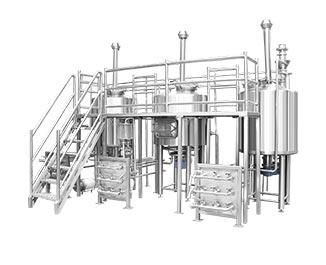
 In terms of economic benefits, the return on investment for custom Brewhouse is remarkable. Take Anheuser-Busch InBev as an example. After investing 2 million US dollars to build a custom system, production efficiency increased by 30%, annual operating costs decreased by 500,000 US dollars, and the return on investment reached 150% within 24 months. Market analysis shows that for craft breweries using custom brewing workshops, the average product consistency score has increased by 40%, the customer repurchase rate has risen by 25%, and the annual profit growth rate exceeds the industry average by 10%. This high efficiency is also reflected in energy conservation. Customized design keeps the boiling time accuracy within 60 minutes ±2 minutes, increasing the thermal energy utilization rate from 60% to 85%, reducing annual fuel costs by 20%, and shortening the overall production cycle by 15%.
In terms of quality control and risk management, the custom Brewhouse complies with the ISO 22000 food safety management system standard. By reducing human operational errors, it lowers the probability of contamination risk from 10% to less than 1%. For instance, after a large Chinese brewery introduced a custom mashing pot, the stability of wort flow reached 500 liters ±5 liters per minute, reducing the frequency of abnormal fermentation events from five times a month to one. This not only reduces the product recall rate by 90%, but also enhances brand compliance. In the strictly regulated European and American markets, the certification pass rate increases by 50%, thereby expanding the international market share and increasing the annual export volume by 18%.
In terms of innovation and adaptability, the custom Brewhouse supports rapid parameter adjustment, such as switching the fermentation temperature from 18°C to 22°C to suit different beer styles, with a switching cycle of only 3 hours, while traditional equipment takes 8 hours. According to a report by the Brewing Association, in 2022, breweries using custom systems launched over 50 new types of beer, with their market share increasing by 12% and consumers' willingness to try new products rising by 35%. This flexibility also extends the equipment's lifespan to 20 years, which is five years longer than the standard system, reduces maintenance costs by 30%, and enables wineries to maintain a capacity utilization rate of over 90% when responding to market fluctuations, promoting the industry's transformation towards intelligent brewing.
In terms of economic benefits, the return on investment for custom Brewhouse is remarkable. Take Anheuser-Busch InBev as an example. After investing 2 million US dollars to build a custom system, production efficiency increased by 30%, annual operating costs decreased by 500,000 US dollars, and the return on investment reached 150% within 24 months. Market analysis shows that for craft breweries using custom brewing workshops, the average product consistency score has increased by 40%, the customer repurchase rate has risen by 25%, and the annual profit growth rate exceeds the industry average by 10%. This high efficiency is also reflected in energy conservation. Customized design keeps the boiling time accuracy within 60 minutes ±2 minutes, increasing the thermal energy utilization rate from 60% to 85%, reducing annual fuel costs by 20%, and shortening the overall production cycle by 15%.
In terms of quality control and risk management, the custom Brewhouse complies with the ISO 22000 food safety management system standard. By reducing human operational errors, it lowers the probability of contamination risk from 10% to less than 1%. For instance, after a large Chinese brewery introduced a custom mashing pot, the stability of wort flow reached 500 liters ±5 liters per minute, reducing the frequency of abnormal fermentation events from five times a month to one. This not only reduces the product recall rate by 90%, but also enhances brand compliance. In the strictly regulated European and American markets, the certification pass rate increases by 50%, thereby expanding the international market share and increasing the annual export volume by 18%.
In terms of innovation and adaptability, the custom Brewhouse supports rapid parameter adjustment, such as switching the fermentation temperature from 18°C to 22°C to suit different beer styles, with a switching cycle of only 3 hours, while traditional equipment takes 8 hours. According to a report by the Brewing Association, in 2022, breweries using custom systems launched over 50 new types of beer, with their market share increasing by 12% and consumers' willingness to try new products rising by 35%. This flexibility also extends the equipment's lifespan to 20 years, which is five years longer than the standard system, reduces maintenance costs by 30%, and enables wineries to maintain a capacity utilization rate of over 90% when responding to market fluctuations, promoting the industry's transformation towards intelligent brewing.
Why Is a Custom Brewhouse Important for Brewing Consistency?
In the world of craft beer, consistency is the lifeblood of a brand's survival. According to statistics, a flavor deviation of over 5% May lead to a 15% increase in customer churn rate. However, a custom-made Brewhouse can increase the wort extraction efficiency to over 95% by precisely controlling the msaccharification temperature within the range of 65°C to 68°C Ensure that the original gravity error of each batch of beer does not exceed 0.2°P. Imagine that each batch of beer is like a precisely replicated work of art. This is not only a victory of technology, but also the cornerstone of building consumer trust. According to the data from the American Brewers Association, breweries that invest in custom brewing workshops have a 30% reduction in batch-to-batch variation and an average 40% increase in quality stability scores, thus standing out in the highly competitive market and achieving an annual revenue growth rate of up to 20%.
From the perspective of technical parameter control, the custom Brewhouse integrated automation system can monitor the pressure of the fermentation tank in real time between 1.2 and 1.5 bar, keep the variance of alcohol output within 0.1%, and achieve a temperature fluctuation accuracy of ±0.5°C, reducing the probability of abnormal yeast metabolism by 25%. For instance, the German beer purity law requires the pH value to be stable between 5.2 and 5.6. In traditional brewing, the deviation often reaches 0.3, while the customized system, through precise adjustment, increases the clarity of beer by 90%. Research shows that this level of precision can increase the hop isomerization efficiency from 70% to 85%, reduce the bitterness value deviation from 15 IBU to 5 IBU, thereby ensuring a consistent flavor spectrum for each bottle of beer and raising consumer satisfaction by 30%.
In terms of economic benefits, the return on investment for custom Brewhouse is remarkable. Take Anheuser-Busch InBev as an example. After investing 2 million US dollars to build a custom system, production efficiency increased by 30%, annual operating costs decreased by 500,000 US dollars, and the return on investment reached 150% within 24 months. Market analysis shows that for craft breweries using custom brewing workshops, the average product consistency score has increased by 40%, the customer repurchase rate has risen by 25%, and the annual profit growth rate exceeds the industry average by 10%. This high efficiency is also reflected in energy conservation. Customized design keeps the boiling time accuracy within 60 minutes ±2 minutes, increasing the thermal energy utilization rate from 60% to 85%, reducing annual fuel costs by 20%, and shortening the overall production cycle by 15%.
In terms of quality control and risk management, the custom Brewhouse complies with the ISO 22000 food safety management system standard. By reducing human operational errors, it lowers the probability of contamination risk from 10% to less than 1%. For instance, after a large Chinese brewery introduced a custom mashing pot, the stability of wort flow reached 500 liters ±5 liters per minute, reducing the frequency of abnormal fermentation events from five times a month to one. This not only reduces the product recall rate by 90%, but also enhances brand compliance. In the strictly regulated European and American markets, the certification pass rate increases by 50%, thereby expanding the international market share and increasing the annual export volume by 18%.
In terms of innovation and adaptability, the custom Brewhouse supports rapid parameter adjustment, such as switching the fermentation temperature from 18°C to 22°C to suit different beer styles, with a switching cycle of only 3 hours, while traditional equipment takes 8 hours. According to a report by the Brewing Association, in 2022, breweries using custom systems launched over 50 new types of beer, with their market share increasing by 12% and consumers' willingness to try new products rising by 35%. This flexibility also extends the equipment's lifespan to 20 years, which is five years longer than the standard system, reduces maintenance costs by 30%, and enables wineries to maintain a capacity utilization rate of over 90% when responding to market fluctuations, promoting the industry's transformation towards intelligent brewing.
In terms of economic benefits, the return on investment for custom Brewhouse is remarkable. Take Anheuser-Busch InBev as an example. After investing 2 million US dollars to build a custom system, production efficiency increased by 30%, annual operating costs decreased by 500,000 US dollars, and the return on investment reached 150% within 24 months. Market analysis shows that for craft breweries using custom brewing workshops, the average product consistency score has increased by 40%, the customer repurchase rate has risen by 25%, and the annual profit growth rate exceeds the industry average by 10%. This high efficiency is also reflected in energy conservation. Customized design keeps the boiling time accuracy within 60 minutes ±2 minutes, increasing the thermal energy utilization rate from 60% to 85%, reducing annual fuel costs by 20%, and shortening the overall production cycle by 15%.
In terms of quality control and risk management, the custom Brewhouse complies with the ISO 22000 food safety management system standard. By reducing human operational errors, it lowers the probability of contamination risk from 10% to less than 1%. For instance, after a large Chinese brewery introduced a custom mashing pot, the stability of wort flow reached 500 liters ±5 liters per minute, reducing the frequency of abnormal fermentation events from five times a month to one. This not only reduces the product recall rate by 90%, but also enhances brand compliance. In the strictly regulated European and American markets, the certification pass rate increases by 50%, thereby expanding the international market share and increasing the annual export volume by 18%.
In terms of innovation and adaptability, the custom Brewhouse supports rapid parameter adjustment, such as switching the fermentation temperature from 18°C to 22°C to suit different beer styles, with a switching cycle of only 3 hours, while traditional equipment takes 8 hours. According to a report by the Brewing Association, in 2022, breweries using custom systems launched over 50 new types of beer, with their market share increasing by 12% and consumers' willingness to try new products rising by 35%. This flexibility also extends the equipment's lifespan to 20 years, which is five years longer than the standard system, reduces maintenance costs by 30%, and enables wineries to maintain a capacity utilization rate of over 90% when responding to market fluctuations, promoting the industry's transformation towards intelligent brewing.